

Abu Dhabi: SiltaNews – News Desk
Saudi Arabia’s Vision 2030 represents one of the most ambitious national transformation strategies in the world today. Designed to reduce dependence on oil, diversify the economy, and modernize society, Vision 2030 places innovation, sustainability, and global competitiveness at its core. Among its most striking initiatives is NEOM, a futuristic mega-project that aims to redefine how cities are built, powered, and experienced.
Vision 2030 was launched to guide Saudi Arabia toward a more diversified and resilient economy. The strategy emphasizes investment in sectors such as technology, tourism, renewable energy, entertainment, and logistics, while also focusing on human capital development and international partnerships. By encouraging foreign investment and attracting global talent, Saudi Arabia seeks to position itself as a leading force in future economic and urban development.
NEOM is a planned smart region in northwestern Saudi Arabia, with an estimated investment exceeding $500 billion. Strategically located along the Red Sea and near major international trade routes, NEOM is envisioned as a living laboratory for advanced technologies, sustainable design, and new economic models. The project is intended to operate entirely on renewable energy and integrate artificial intelligence into daily life, governance, and infrastructure.
At the heart of NEOM lies The Line, a revolutionary urban concept that challenges traditional city planning. The Line is designed as a 170-kilometer-long, 200-meter-wide, and 500-meter-high linear city made up of two parallel mirrored structures. It aims to accommodate up to nine million residents while maintaining a zero-carbon footprint.
The city eliminates the need for cars and roads, relying instead on walkable neighborhoods and a high-speed rail system capable of transporting residents from one end of the city to the other in just 20 minutes. Essential services such as schools, healthcare facilities, workplaces, and recreational spaces are planned to be accessible within a five-minute walk, improving quality of life and reducing environmental impact. By preserving approximately 95% of the surrounding natural environment, The Line seeks to balance urban density with ecological conservation.
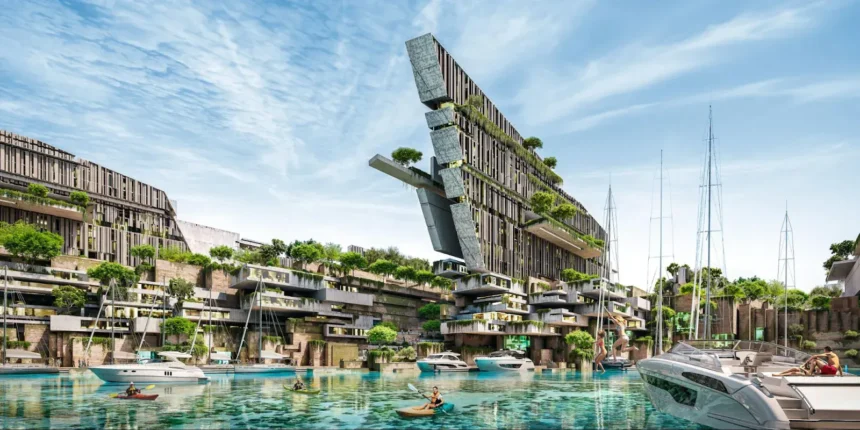
NEOM consists of several complementary projects that support its vision of a diversified future. OXAGON, a floating industrial city, focuses on advanced manufacturing and logistics powered by clean energy. TROJENA, a mountain destination, is designed for year-round tourism and will host international sporting events, including winter sports. SINDALAH, a luxury island resort, aims to attract global tourism and maritime investment along the Red Sea coast.
NEOM is expected to play a crucial role in Saudi Arabia’s economic diversification efforts. The project is designed to create hundreds of thousands of high-skilled jobs and attract international investors, entrepreneurs, engineers, and researchers. Beyond national borders, NEOM has the potential to influence global urban planning by demonstrating new approaches to sustainability, smart infrastructure, and compact city design.
Despite its bold vision, NEOM has attracted debate and criticism. Questions remain regarding the technical feasibility, cost, and long-term timeline of constructing The Line at its full scale. Environmental and social concerns, including land use and community relocation, have also been raised. Saudi authorities have stated that the project will be developed in phases, allowing for adaptation and technological refinement over time.
NEOM stands as one of the most daring urban experiments of the 21st century. As a centerpiece of Saudi Arabia’s Vision 2030, it reflects the Kingdom’s desire to lead in innovation, sustainability, and future city development. Whether fully realized or not, NEOM is already reshaping global conversations about how cities of the future might look, function, and coexist with the natural environment.