

Beijing: SiltaNews – News Desk
China plans to launch its Chang’e-7 lunar probe this year to explore the Moon’s south pole and search for water ice, a resource considered vital for future long-term human presence and potential lunar bases, the Global Times reported on Wednesday, citing the state-owned China Aerospace Science and Technology Corporation (CASC).
Sun Zezhou, a deputy to the 14th National People’s Congress and a senior engineer in China’s lunar exploration programme at CASC’s China Academy of Spacecraft Technology, said on the sidelines of the annual “two sessions” meetings that Phase 4 of China’s lunar exploration programme is progressing steadily.
The Chang’e-7 mission will conduct detailed surveys of the lunar south polar environment and search for water ice deposits in the regolith, while carrying out high-precision studies of lunar topography, composition and geological structure, Sun said. China is also advancing broader interplanetary exploration plans. The Tianwen-3 mission aims to return samples from Mars to study the planet’s environment, while Tianwen-4 will target Jupiter and its moons to investigate the gas giant’s magnetosphere and internal structure.
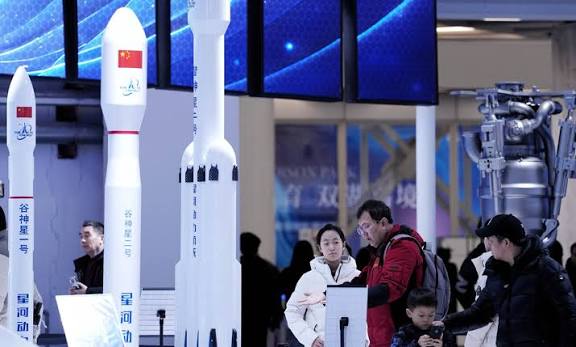
Besides the robotic deep-space missions, China’s manned lunar exploration programme also continues to make steady strides toward the ambitious goal of landing Chinese astronauts on the Moon before 2030, with development work advancing smoothly and a series of critical milestones achieved in recent months, according to the CASC. Currently, the development of major flight products, including the Long March-10 carrier rocket, the Mengzhou new-generation crewed spacecraft, and the Lanyue lunar lander, is progressing smoothly, the CASC disclosed in a statement sent to the Global Times.
A series of large-scale tests in the prototype phase have been successively completed, such as the Mengzhou crewed spacecraft zero-altitude escape flight, the Lanyue lander landing and liftoff verification, the Long March-10 carrier rocket tethered ignition, electrical assembly testing of the lunar spacesuit components, thermal-vacuum and force tests on the crewed lunar rover, the Long March-10 carrier rocket system low-altitude demonstration verification, and the Mengzhou crewed spacecraft system maximum dynamic pressure escape flight. Subsequently, the programme will transition as planned to the formal sample development phase, said the space giant.