

Abu Dhabi: SiltaNews – News Desk
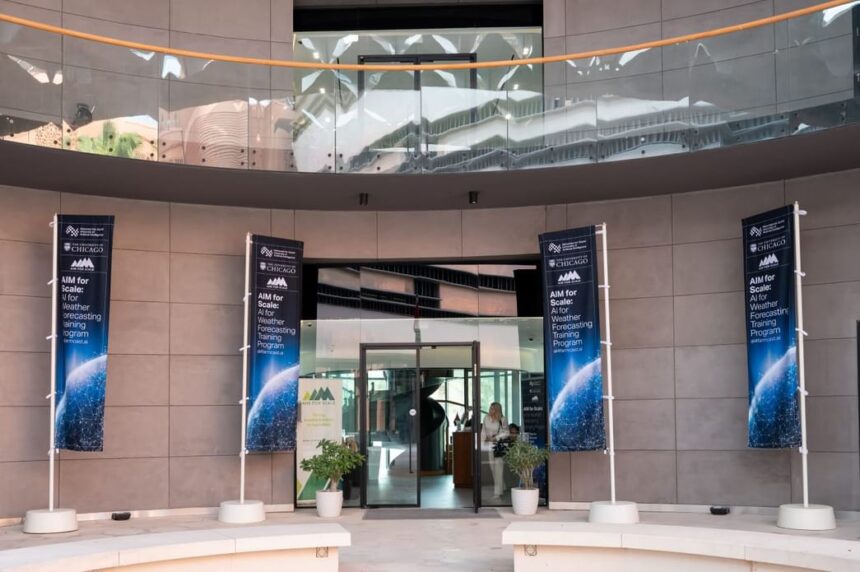
The Mohamed bin Zayed University of Artificial Intelligence (MBZUAI), the M4Scale initiative, and the University of Chicago have launched a unique training program in weather forecasting. The program aims to help governments provide customized forecasts that meet local agricultural needs, including the needs of millions of farmers.
With climate change imposing increasingly volatile weather patterns on communities around the world, advances in artificial intelligence technologies are enabling predictions of these changes more quickly, at a lower cost, and with superior local accuracy. This achievement is expected to contribute to providing accurate forecasts to areas that previously lacked the latest technology.
With support from the A4Scale Agricultural Innovation Mechanism, researchers from the Mohamed bin Zayed University of Artificial Intelligence and the University of Chicago are working to enable governments in low- and middle-income countries to adopt these innovations early and build world-class national services.
“AI-enhanced weather models are revolutionizing forecasting capabilities, but because the technology is new, governments often lack the training, equipment, and institutional capacity to build and use them effectively,” said Badram Hassanzadeh, associate professor in the Department of Geophysical Sciences at the University of Chicago and a member of the A4Scale Farmer Weather Services Technical Committee. “If we don’t act now, low- and middle-income countries will be left behind. We are working to ensure these countries are able to harness these innovations by bringing the latest in AI and climate science from the lab to the field.”
The pilot program trains personnel from national meteorological and hydrological services and ministries of agriculture in low- and middle-income countries on how to use AI-enhanced weather forecasting models tailored to their local needs. The first batch included participants from Bangladesh, Chile, Ethiopia, Kenya, and Nigeria. They are undergoing training from September 22 to 26 in the UAE, hosted by the Mohamed bin Zayed University of Artificial Intelligence and the National Center of Meteorology.
The program is scheduled to include an additional 25 countries in the coming years, bringing the total to 30, expanding its reach to millions of farmers around the world. The M4Scale initiative is working with development partners to ensure this effort is scalable, comprehensive, and delivers a tangible impact for farmers.
“Accurate, high-quality forecasts can unlock improved productivity, higher incomes, and more stable livelihoods for farmers,” said Paul Winters, executive director of A4Scale and professor of global affairs at the Keough School of Global Affairs at the University of Notre Dame. “By combining AI innovation with practical agricultural decision-making, we are creating opportunities for millions of farmers to thrive. This training covers the essential dimensions of AI-enhanced weather forecasting, from climate data to model validation and allocation techniques, enabling farmers to plan amidst uncertainty and demonstrating how advanced AI research can translate into practical solutions to global challenges such as food security,” said Suhaib Bin Tayeb, Associate Professor of Statistics and Data Science at MBZUAI.
“The training is a powerful example of how AI can be used for global public good,” said Amir Jena, associate professor at the University of Chicago’s Harris School of Public Policy and chair of the M4Scale technical committee. “For the first time, there is a real possibility of providing equitable access to the world’s best weather forecasts, enabling low- and middle-income countries to build national services that match the highest standards offered by the most developed nations.”
In addition to the Mohamed bin Zayed University of Artificial Intelligence, AIM4Scale, the University of Chicago, and the National Center of Meteorology, the program includes experts from leading global institutions, including the World Meteorological Organization, Google DeepMind, Google Research, the European Centre for Medium-Range Weather Forecasts (ECMWF), AfriClimate AI, the Norwegian Meteorological Institute, Precision Development, and others.