

Johannesburg: SiltaNews – News Desk
While the world often looks to South Africa for its political history or safari sunsets, the “Rainbow Nation” is currently making headlines for reasons that are much older – and some much newer – than you might expect. As we move into 2026, here are three fascinating non-tech stories defining the country today.
1. The World’s “Oldest” Neighborhood isn’t in Europe
We often think of ancient history in terms of Roman ruins or Egyptian pyramids, but South African geologists and historians are currently highlighting the Makhonjwa Mountains in Mpumalanga. Known as the “Genesis of Life,” these mountains contain rocks dating back 3.6 billion years.
Unlike other ancient ranges that have been folded or tucked away, the Makhonjwa range is so well-preserved that researchers are currently using it to understand how the very first cells formed on Earth. It is, quite literally, the closest thing we have to a “memory” of the planet’s birth.
2. The “Generosity Capital” of the World
In a surprising turn for global social studies, recent data from the Interpersonal Generosity Scale (2025/2026) has ranked South Africans among the most generous people globally. This isn’t just about financial donations; it’s a reflection of Ubuntu – the philosophy that “I am because we are.”
Whether it is the informal “Stokvel” savings clubs that move billions of Rands through community trust or the fact that South Africa has more official languages (12, with the recent inclusion of South African Sign Language) than almost any other nation, the country is a living laboratory of how diverse cultures co-exist and support one another through “social scaffolding.”
3. The Only “Green” Canyon on Earth
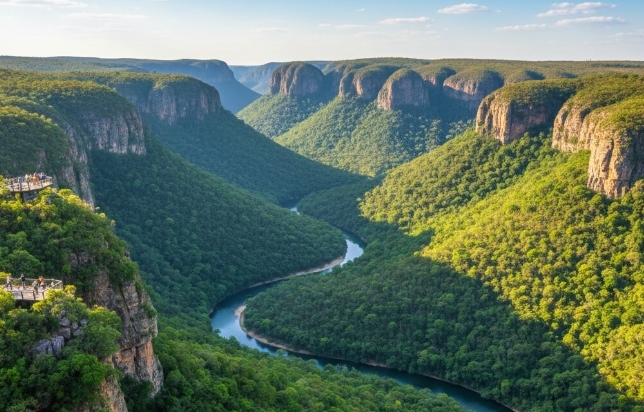
You’ve heard of the Grand Canyon, but did you know South Africa is home to the Blyde River Canyon, the largest “green” canyon in the world? While most canyons are arid and desert-like, Blyde River is draped in lush, subtropical foliage.
As of 2026, it has become a global focal point for “Biodiversity Economics.” While it takes up only 2% of the world’s land surface, South Africa contains 10% of the world’s plant species. In the Cape Floral Kingdom alone, there are more plant species on a single mountain (Table Mountain) than in the entire United Kingdom.