

Abu Dhabi: SiltaNews – News Desk
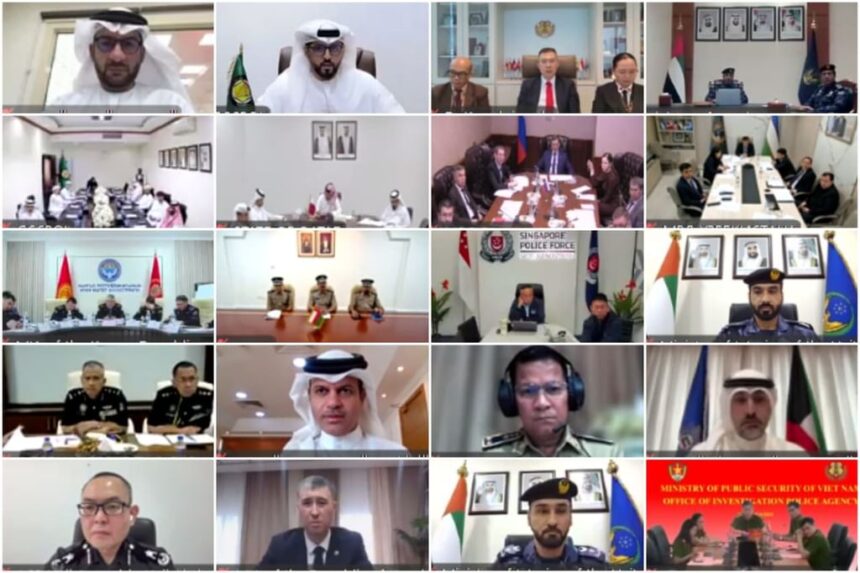
The Ministry of Interior (MOI), in collaboration with the GCC Police and ASEANAPOL, convened the first meeting of Gulf–Asian Directors General of Criminal Investigations, held virtually, to deepen cooperation between GCC member states and Asian counterparts in tackling organised and transnational crime.
The meeting brought together Brigadier Saeed bin Tuwair Al Suwaidi, Assistant Undersecretary for Security Affairs at the MOI; Brigadier Abdulaziz Abdullah Al Ahmad, Director-General of the Federal Criminal Police; Brigadier Mubarak Saeed Al Khaili, Director-General of the GCC Police; Dr. Kongkrissada Kittithiraphong, Executive Director of ASEANAPOL; Lt. Colonel Saeed Al Kaabi, Director of the International Cooperation Department; alongside senior law enforcement officials from both organisations and representatives of the GCC General Secretariat.
In his opening remarks, Brigadier Al Suwaidi stressed the strategic significance of the meeting in stepping up security cooperation. He conveyed the greetings of H.H. Lt. General Sheikh Saif bin Zayed Al Nahyan, Deputy Prime Minister and Minister of the Interior, along with his wishes for the meeting’s success in reinforcing joint security efforts and strengthening strategic partnerships.
Al Suwaidi highlighted that evolving security threats demand greater coordination and intensified collaboration among partner nations, particularly in criminal investigations and intelligence sharing, noting that such cooperation enhances the operational effectiveness of security agencies.
He reaffirmed the ministry’s steadfast commitment to supporting regional and international partnerships in pursuit of security and stability. For his part, Brigadier Al Khaili emphasised that the meeting comes amid rapidly shifting crime patterns and methods, which call for heightened readiness, continuous capability development, and closer coordination among law enforcement entities.
Al Khaili described the forum as a strategic platform for exchanging expertise and advancing more effective cooperation frameworks, including developing joint coordination operations, establishing working groups, and strengthening information exchange. He further expressed hope that the meeting would yield practical outcomes and a clear implementation roadmap to guide future collaboration, affirming that safeguarding societies and enhancing stability is a shared global responsibility, and that collective action today represents an investment in a safer future.
Dr. Kongkrissada outlined the organisation’s role in promoting police cooperation across Southeast Asia, highlighting its efforts in coordinating joint operations, facilitating information exchange, and combating transnational crime. He stressed the importance of the meeting in advancing unified operational frameworks and strengthening international collaboration to effectively address emerging security challenges.
Lt. Colonel Al Kaabi reaffirmed the ministry’s commitment to hosting such international engagements, reflecting its dedication to advancing security initiatives that align perspectives and foster coordinated action. He also highlighted the UAE’s role as a trusted global partner in convening high-level forums and strengthening cooperation with strategic stakeholders.
Discussions during the meeting focused on sharing best practices and addressing key transnational threats, including cybercrime, financial crimes, money laundering, online child exploitation, human trafficking, and environmental crime. Participants explored avenues to enhance response mechanisms and accelerate the exchange of criminal intelligence in support of investigations. The meeting also highlighted the importance of institutionalising frameworks for coordinating joint international operations, alongside strengthening training and capacity-building programmes to elevate readiness in addressing evolving threats.
The meeting concluded with several actionable outcomes: forming specialised working groups to address shared criminal challenges; designating focal points for priority areas such as cybercrime, artificial intelligence, financial fraud, online child exploitation, human trafficking, and money laundering; and enhancing law enforcement capabilities through structured coordination and advanced information-sharing mechanisms. These outcomes mark a significant step forward in shaping the next phase of Gulf–Asian cooperation, reinforcing collective efforts to combat crime and enhance community safety.